

Managing a global team used to require a massive corporate budget, months of legal back-and-forth, and thousands of dollars spent setting up foreign entities. Today, platforms like Deel promise to handle everything—international onboarding, compliance, and multi-currency payroll—with a few clicks.
But when you are dealing with thousands of dollars in payroll, strict international labor laws, and sensitive employee data, it is natural to ask: Is Deel a legitimate company, or is it a compliance nightmare waiting to happen?
This guide provides an objective breakdown of Deel’s legal standing, security frameworks, pricing models, and operational infrastructure to help you decide if it is the right fit for your expanding team.
Is Deel Legitimate? (The Direct Answer)
Yes, Deel is a fully legitimate, enterprise-grade global HR and payroll company. Founded in 2019, Deel has rapidly grown into a market leader in the remote work infrastructure space.
- Massive Global Scale: Deel manages payroll and compliance for over 40,000 companies across more than 150 countries.
- Backed by Leading Brands: High-growth startups and established global brands alike—including Boston Consulting Group (BCG), Revolut, Shopify, and Reddit—rely on Deel to run their international teams.
- Financial Footprint: Deel processes billions of dollars in global transactions annually, backed by premier venture capital firms like Andreessen Horowitz, Spark Capital, and Coatue.
Rather than acting as a simple digital overlay or payment processor, Deel functions as a comprehensive legal bridge connecting companies with talent worldwide.
What is Deel and How Does It Work?
Deel is an all-in-one global HR software system (HRIS) designed to manage the entire lifecycle of an international workforce. It consolidates independent contractor management, Employer of Record (EOR) services, immigration, and global payroll into a single dashboard.
When a company wants to hire a worker in another country, they typically face two major hurdles: local tax compliance and employment laws. Deel bridges this gap using two primary models:
- Contractor Management: Deel automates localized contract generation, tracks tax forms (like W-8BEN or W-9), and enables seamless multi-currency payouts for freelance talent.
- Employer of Record (EOR): If you want to hire full-time talent in a country where you do not own a local legal entity, Deel acts as the legal employer on paper. They handle local payroll, mandatory benefits, and tax filings, while the worker reports directly to you for day-to-day operations.
Deel’s Core Infrastructure: Why It’s Truly Safe
The biggest indicator of Deel’s legitimacy is its owned-entity infrastructure.
Many competitors in the global payroll space rely on a “partner-dependent” model, meaning they outsource your international employees to local, third-party HR agencies in each country. This often results in communication delays, hidden fees, and varied compliance standards.
Deel operates differently. They have invested heavily in establishing over 100+ fully owned legal entities around the globe.
By owning the local infrastructure, Deel retains full control over the employee experience, provides consistent legal protection, and eliminates the middleman risks associated with traditional international hiring.
Key Features That Protect Businesses and Remote Workers
Deel is built to mitigate the risks associated with hiring across borders. Its core features focus heavily on automation and legal compliance:
- Employer of Record (EOR) Services: Seamlessly hire full-time workers globally. Deel assumes 100% of the legal employer liability, protecting your business from accidental non-compliance.
- Contractor Misclassification Protection (Deel Shield & Contractor of Record): Government audits targeting misclassified contractors are on the rise. Deel uses advanced compliance engines to analyze worker relationships, offering tiers like Deel Shield to assume liability and protect your company from steep classification penalties.
- Continuous Compliance Engine: Deel retains an in-house network of over 2,000 legal, tax, and labor experts globally. The platform automatically updates contracts and payroll rules in real time whenever local labor laws alter minimum wages, termination notices, or statutory benefits.
- Device & Lifecycle Management (Deel IT): Beyond payroll, Deel allows companies to order, provision, and ship enterprise laptops directly to international employees, handling local customs clearance and retrieval upon offboarding.
Deel Pricing Plans: Costs, Tiers, and TCO
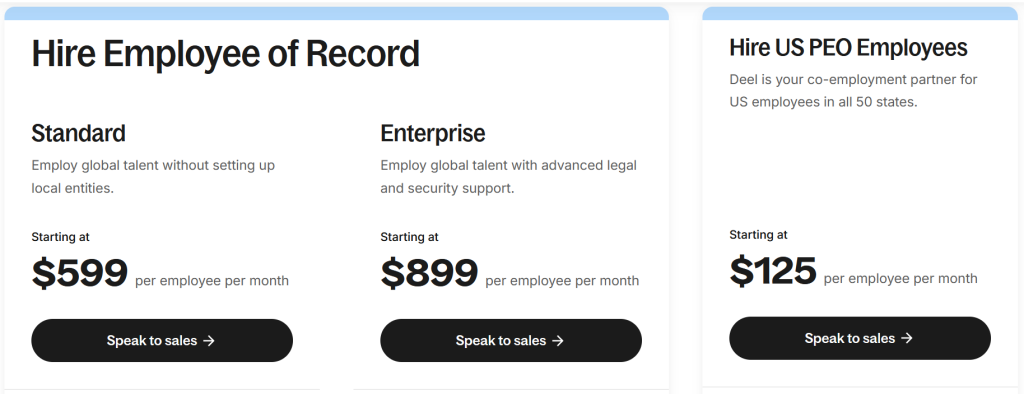
Deel maintains a clear, publicly available base pricing structure. However, when calculating your Total Cost of Ownership (TCO), remember that base platform fees do not include local statutory employer costs (such as payroll taxes, social contributions, and health insurance mandates).
The standard operational tiers reflect the following pricing structures:
| Service / Plan | Base Price (Per Month) | Best Suited For | Key Inclusions |
| Deel HR | Free (Up to 200 workers) | Small to mid-sized teams | Global HRIS, org charts, document management, time-off tracking. |
| Contractor Management | $49 / contractor | Managing international freelancers | Localized contract generation, automated invoicing, compliance collection, 150+ currencies. |
| Global Payroll | $29 / employee | Teams with pre-existing local entities | Consolidated payroll engine, localized tax filings, unified multi-country reporting. |
| Contractor of Record | $325 / contractor | High-risk freelancer relationships | Enhanced worker classification analysis, full misclassification risk mitigation. |
| Employer of Record (EOR) | $599 / employee | Hiring full-time international staff | Full legal employment infrastructure, localized benefits administration, 100% liability coverage. |
Note on Payment Processing: When funding payroll runs, transaction fees vary based on the provider. While automated clearing house (ACH) transfers carry a flat fee of around $5, credit/debit card processing can add an additional 2.9% to 3.9% to the invoice total.
Security, Compliance, and Data Protection
When distributing payroll internationally, bank-grade data protection is non-negotiable. Deel ensures corporate data security through several critical standards:
- Certifications: Deel is fully SOC 2 Type II compliant, proving that its internal controls protect client data effectively over extended periods.
- Data Privacy Regulations: The platform adheres strictly to international data laws, including Europe’s GDPR and Brazil’s LGPD.
- Financial Rail Encryption: All payment routing, employee bank details, and corporate funds are protected using advanced corporate SSL encryption and handled via stable, top-tier global banking partners.
Deel Reviews: What Do Users and Businesses Say?
Aggregated feedback across platforms like G2 and Trustpilot rates Deel consistently high, usually averaging between 4.5 to 4.8 out of 5 stars.
The Pros:
- Punctual Payouts: Contractors and full-time employees praise the platform for predictable, on-time monthly payments.
- Flexible Withdrawal Infrastructure: Contractors value having over 15 payment methods and 8 withdrawal channels, ranging from standard bank wire transfers and Revolut to PayPal and stablecoin options.
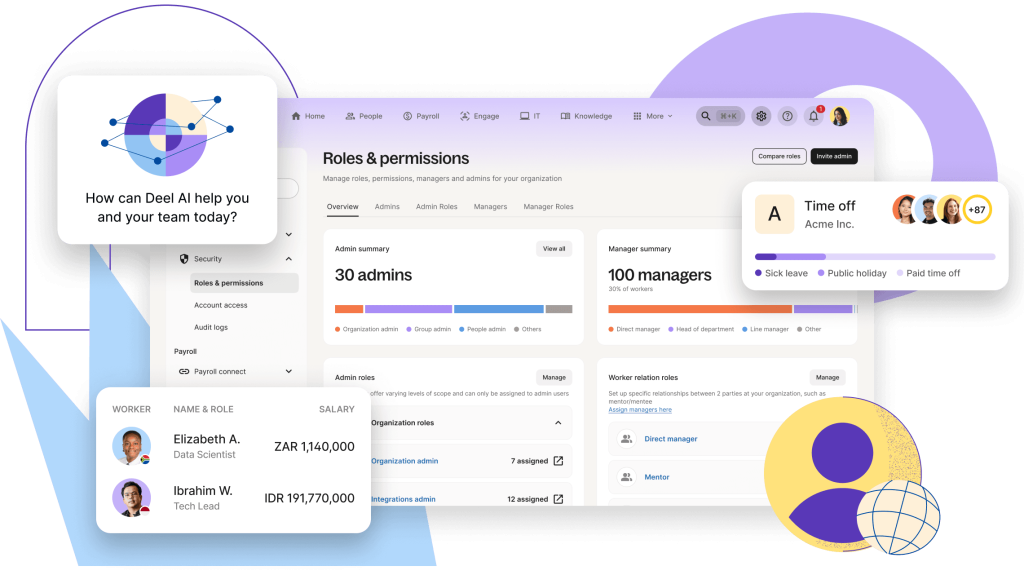
- Intuitive UI: Both HR teams and new hires report a smooth, self-service onboarding flow with minimal platform learning curves.
The Cons:
- Complex Onboarding for Niche Markets: While onboarding in major tech hubs takes only days, setting up EOR employees in highly bureaucratic jurisdictions with complex local requirements can sometimes take longer than expected.
- Tier Stacking: Companies scaling rapidly note that add-on features—such as background checks, IT logistics, or custom HR modules—can cause invoice amounts to scale up quickly if not budgeted correctly.
Deel vs. Competitors (Rippling, Remote, Oyster)
How does Deel stand against other major players in the global HR space?
- Deel vs. Remote: Both rely heavily on owned legal entities rather than third-party partners. Deel generally wins out on overall geographic footprint and the variety of payout options available to contractors.
- Deel vs. Rippling: Rippling is an incredibly powerful option if your primary focus is deeply technical US-based IT and device management. However, for companies prioritizing rapid, global expansion across dozens of countries without local entities, Deel’s EOR framework is often simpler to deploy out-of-the-box.
- Deel vs. Oyster: Oyster operates a solid global platform but leverages third-party partners more heavily in certain mid-market countries. Deel’s owned-entity model gives it an advantage in speed-of-resolution and cost predictability in those areas.
How to Get Started with Deel: A Step-by-Step Procedure
Setting up an account and creating your first localized contract can be completed seamlessly using the following workflow:
1.Create Your Corporate Profile:Takes under 5 minutes.
Sign up on Deel’s website, complete your standard business profile verification, and configure your primary corporate dashboard.
2.Select Your Worker Class:Determine worker classification.
Choose between onboarding an independent freelancer via Contractor Management, utilizing a full Employer of Record path, or running Global Payroll through your pre-existing local entities.
3.Generate Localized Agreements:Automated legal protection.
Input the worker’s local jurisdiction, salary details, and role specifications. Deel’s legal engine automatically generates an agreement that complies fully with local tax and labor laws.
4.Onboard and Fund Payroll:Launch active engagement.
Invite the worker to log into their secure self-service portal to sign the agreement and upload required local tax documentation. Once verified, fund your dashboard using your preferred payment method to initiate the billing cycle.
Frequently Asked Questions (FAQs)
Is Deel legal in the US and internationally?
Yes. Deel functions in total compliance with the United States Department of Labor frameworks, internal revenue guidelines, and corresponding international ministries of labor across more than 150 countries.
How do international contractors get paid on Deel?
Contractors can withdraw their funds via multiple methods, including direct local bank deposits, SEPA transfers, wire transfers, PayPal, Payoneer, Revolut, and supported digital token accounts.
Does Deel handle local tax filings?
For full-time EOR workers, Deel manages all statutory payroll deductions, local taxes, and annual filings automatically. For US-based contractors, the system handles automated 1099 and W-8BEN/W-9 document collection and processing.
Final Verdict: Is Deel Worth It for Your Business?
If you are a business looking to hire, manage, and pay global talent without spending the time and capital required to establish dozens of foreign entities, Deel is an exceptionally secure, legitimate, and efficient solution.
Its commitment to an owned-entity model ensures that your company remains fully insulated from compliance issues, allowing you to focus on scaling your distributed workforce with total peace of mind.
Simplify Your Global Hiring Today
Ready to eliminate the administrative headache of international payroll and compliance? Join thousands of high-growth businesses using Deel to build compliant, world-class remote teams.
Click here to sign up for your account or book a live demo with a Deel global HR expert today.
Leave a Reply