

There is a dangerous lie circulating in the marketing world, and it is costing businesses millions of dollars in lost revenue and wasted hours. The lie is this: “Your marketing platform doesn’t matter; it is just a tool.”
This sentiment sounds incredibly wise and grounded. It implies that strategy trumps technology. But it is fundamentally false. In the modern digital landscape, your marketing platform is not just a hammer or a wrench; it is the nervous system of your entire business. If that nervous system is slow, disjointed, or excessively expensive, your business will move like a dinosaur in a world of predators.
For years, I bought into the illusion. I bounced between the industry giants. I started where everyone starts—the colorful, friendly confines of Mailchimp. When I outgrew that, I bought into the prestige and heavy price tag of HubSpot. I even dabbled with Klaviyo when I thought deep e-commerce integration was the silver bullet.
But every time, I hit a wall. I found myself fighting against the software rather than leveraging it. I was doing manual labor inside platforms that promised “automation.”
It wasn’t until I migrated my entire infrastructure to ActiveCampaign that I realized what true marketing leverage feels like. If you are currently sitting on the fence, frustrated by your current provider’s limitations, pricing, or clunky interface, this is your wake-up call. Here is the unvarnished truth about where the competitors fail, and why ActiveCampaign is the only logical choice for the modern marketer.
The Mailchimp Ceiling: When “Basic” Becomes a Liability
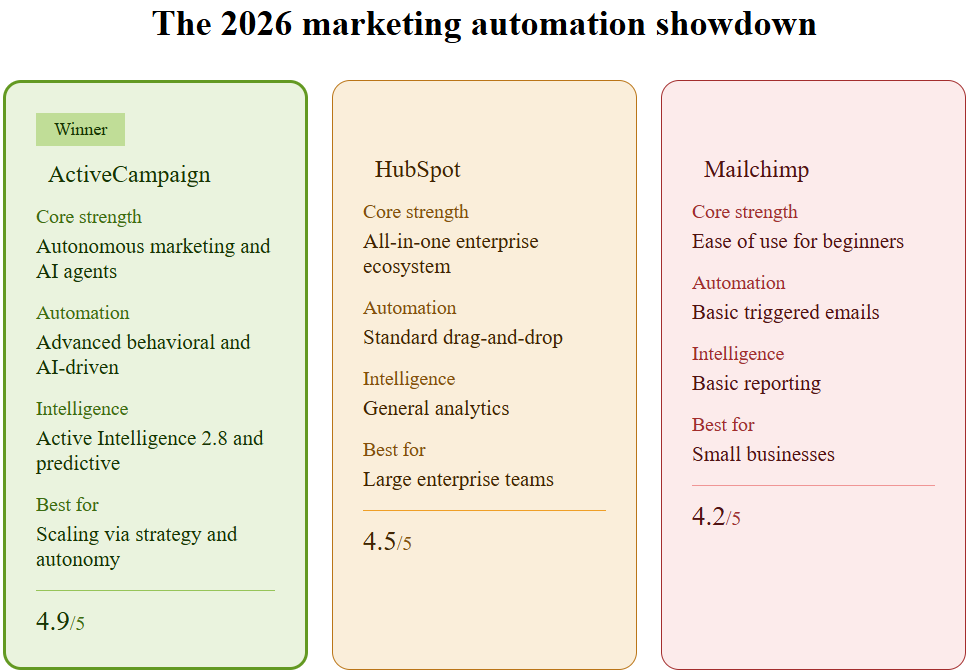
Mailchimp is the undisputed king of the starting line. It is famously easy to use, visually appealing, and practically free when you have zero audience. But Mailchimp is designed for broadcasting, not conversing.
The moment your business matures beyond sending a weekly newsletter to a static list, Mailchimp becomes a straitjacket.
The core issue lies in its architecture. Mailchimp is fundamentally list-centric. If John Doe subscribes to your “Newsletter” list and later buys a product, putting him on your “Customers” list, Mailchimp historically treats him as two separate entities. You pay for him twice, and worse, his behavioral data is siloed.
When you try to build complex, behavioral automations in Mailchimp—say, triggering a highly specific email sequence based on a user visiting a specific pricing page, watching 50% of a video, and having a lead score over 80—the platform simply gasps for air. It forces you into rigid “If/Then” paths that lack nuance.
You do not outgrow Mailchimp because you get too big; you outgrow Mailchimp because you get too smart. The moment you realize that personalized behavioral marketing is where the money is, the Mailchimp ceiling crashes down on you.
The HubSpot Trap: Paying for Bloat Instead of Brains
When companies hit the Mailchimp ceiling, they usually panic and run in the opposite direction. They seek out the biggest, most “enterprise” solution available. Enter HubSpot.
HubSpot is a phenomenal piece of software, but it operates on a business model that I can only describe as a “feature hostage situation.” They draw you in with a robust free CRM. You start using their marketing tools, and everything feels seamlessly integrated.
And then, you need to add a few more contacts. Or you need a specific type of custom reporting. Or you want to use a slightly more advanced automation trigger.
Suddenly, your monthly bill jumps from $50 to $800. Then to $2,000. HubSpot’s pricing tiers are notoriously steep, aggressively punishing businesses for scaling. You end up paying for a massive suite of tools—CMS, Service Hubs, Operations Hubs—that you likely do not need, just to get access to the core marketing features that actually drive revenue.
Furthermore, HubSpot’s automation builder, while powerful, is incredibly rigid. It is a heavy, cumbersome beast. Making a quick pivot or adjusting a live campaign feels like trying to turn a cargo ship. You spend more time managing the software and navigating their proprietary ecosystem than you do actually connecting with your audience. You are paying for enterprise bloat, not marketing agility.
The Klaviyo Silo: Brilliant for Carts, Blind to Context
For a time, Klaviyo became the darling of the marketing world, specifically for Shopify users. And credit where it is due: Klaviyo’s deep data integration with e-commerce platforms is exceptional. If your only goal is recovering abandoned carts and sending post-purchase cross-sells, Klaviyo is a beast.
But business is rarely that one-dimensional. What happens when your e-commerce brand wants to launch a B2B wholesale wing? What happens if you sell digital courses alongside physical products? What if your sales cycle requires long-term, educational nurturing rather than just a quick discount code?
Klaviyo struggles deeply outside the narrow lane of direct-to-consumer e-commerce. Its CRM capabilities are rudimentary compared to its competitors. It doesn’t handle complex pipeline management or deal tracking effectively. It is a brilliant tool for a highly specific job, but it forces you to duct-tape other software onto it if you want to run a holistic business.
The ActiveCampaign Paradigm Shift: Welcome to Autonomy
This brings us to the great migration. Why did I ultimately move everything to ActiveCampaign, and why do I refuse to look back?
Because ActiveCampaign is the only platform that fundamentally understands the difference between automation and autonomy.
Competitors give you a blank canvas and say, “Here are the tools, go build a workflow.” If you are a master architect, great. If you are a busy business owner, you end up building a fragile, tangled mess.
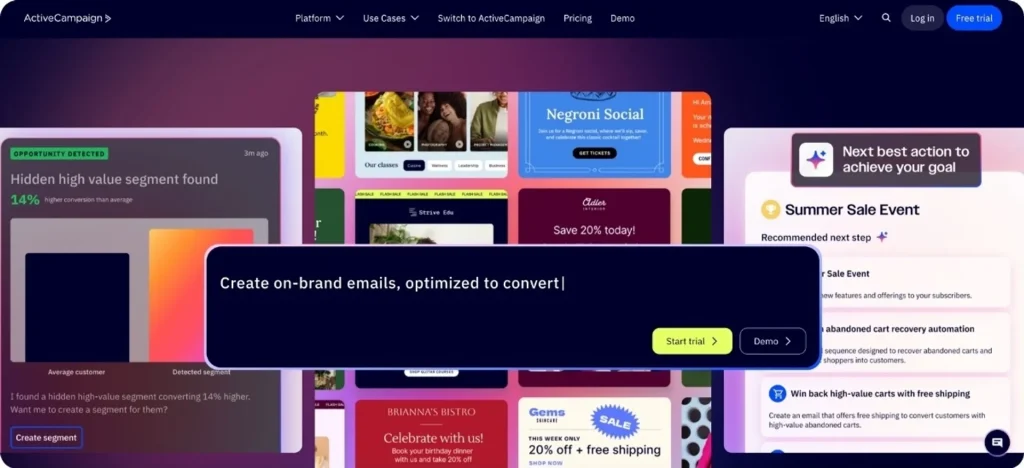
ActiveCampaign changed the game entirely with Active Intelligence 2.8. They didn’t just add an AI text generator like everyone else; they introduced functional AI Agents. This is not a gimmick; it is a structural paradigm shift in how marketing operates.
Instead of fighting with logic paths and dragging hundreds of boxes onto a screen, I now interact with my marketing platform like a trusted colleague. I can open the Active Intelligence prompt and instruct it: “Analyze my last three product launches, identify the segment of users who clicked but didn’t buy, and generate a 4-day re-engagement sequence tailored to their specific objections.”
The AI Agent doesn’t just write the copy; it builds the automation framework. It structures the delivery logic. And crucially, it utilizes Predictive Sending. ActiveCampaign analyzes the historical open behaviors of every single user in your database and delivers your message at the exact moment they are most likely to be looking at their inbox. You cannot do that manually.
Data Fluidity: The Power of Tag-Based Architecture
Beneath the AI magic lies ActiveCampaign’s true superpower: its data architecture. Unlike Mailchimp’s rigid lists or HubSpot’s bloated contact records, ActiveCampaign relies on a fluid, tag-based system intertwined with a remarkably powerful, visual CRM.
A single contact lives in your database, and their entire journey—every email opened, every web page visited, every custom tag applied—is tracked in one clean timeline. This allows for hyper-segmentation that feels almost telepathic to the end-user.
If a prospect reads a blog post about SEO, clicks a link in an email about Content Marketing, but ignores your social media services, ActiveCampaign allows you to instantly trigger a highly specific, dynamically personalized workflow focusing only on SEO and Content. You are no longer shouting into a crowd; you are whispering directly into the ear of a highly qualified buyer.
The ROI Equation: Paying for Power, Not Privilege
Let’s talk about the reality of cost. With HubSpot, scaling your contact list feels like a punishment. With ActiveCampaign, it feels like a partnership.
ActiveCampaign provides enterprise-level power—deep logic, multi-channel messaging, SMS integration, machine learning, and advanced CRM pipelines—at a fraction of the cost of HubSpot. You are not forced to buy into a “walled garden” ecosystem. ActiveCampaign integrates beautifully with thousands of other specialized tools, allowing you to build a modular, best-in-class tech stack rather than being locked into one company’s proprietary (and expensive) universe.
You are paying for pure, concentrated marketing horsepower, not the bloated overhead of a massive software suite.

The “Human-in-the-Loop” Advantage
With all this talk of AI and autonomous agents, it is easy to assume the goal is to set the machine and walk away. But the true genius of ActiveCampaign’s ecosystem is how it honors the Human-in-the-Loop philosophy.
The competitors try to force you into their rigid templates. ActiveCampaign’s Active Intelligence uses a feature called the Brand Kit and Custom Instructions. You teach the AI your voice, your specific industry nuances, and your strategic boundaries.
The AI handles the heavy lifting—the data processing, the predictive timing, the initial drafting, and the structural building. But you remain the Editor-in-Chief. The platform is designed to present you with optimized options that you review, refine, and deploy. The AI is only as powerful as the human strategy behind it. ActiveCampaign doesn’t replace the marketer; it removes the busywork so the marketer can actually focus on strategy, psychology, and connection. That human perspective is the ultimate competitive advantage in an increasingly automated world.
The Migration Imperative: Stop Settling
Switching marketing platforms is painful. It requires exporting lists, rebuilding automations, and retraining your brain. I know this because I have done it. The inertia of staying with a “good enough” platform is incredibly strong.
But “good enough” is the enemy of growth.
If you are fighting your software, if you are guessing at your segmentation, if you are paying thousands of dollars for features you don’t use, or if you are manually building every single step of your customer journey, you are losing. You are bleeding time and leaving money on the table.
ActiveCampaign is not just an alternative; it is an evolution. It bridges the gap between the simplicity you want and the enterprise-level power you actually need to scale.
It is time to stop being a tactical button-pusher and start acting as the strategic architect of your business. Break the chains of legacy software. Embrace the autonomous era.
Click here to start your journey with ActiveCampaign today.
The future of marketing isn’t just automated. It is intelligent.
Leave a Reply