
There is a specific kind of exhaustion that every marketer knows intimately. It is 4:00 PM on a Tuesday. You have three email campaigns to build, a disjointed list to segment, and a reporting dashboard that is giving you an overwhelming amount of data but absolutely zero actionable answers. You aren’t “doing marketing” anymore—you are just pushing buttons. You have become an administrative assistant to your own software.
We have spent the last decade obsessed with the buzzword of “automation.” But here is the dirty little secret the industry rarely admits: Traditional automation is just a faster, more complicated way to do manual labor. If you do not meticulously set up every single trigger, define the exact logic paths, and write the static content for every possible scenario, nothing happens. You are the conductor, the composer, the musicians, and the person sweeping the stage after the show.
That changes today.
Recently, I decided to aggressively test a completely new paradigm: Autonomous Marketing. I put ActiveCampaign’s Active Intelligence and their new suite of AI Agents to the test to see if they could actually handle the heavy, strategic lifting of my business. The results were more than just “faster workflows”—they represented a complete and total shift in my daily role. I transitioned from being a tactical button-pusher to acting as the Chief Strategy Officer of my own brand.
The “Invisible Ceiling” Problem in Traditional Automation
Most of us hit an invisible ceiling when we attempt to scale our operations. You can only write so many emails, design so many landing pages, and build so many automation flows before the quality inevitably dips. When you try to scale personalization—attempting to truly personalize the journey for tens of thousands of subscribers—you end up with “Frankenstein” workflows. These are those massive, sprawling automation maps that look like a bowl of spaghetti and are completely impossible to troubleshoot when something breaks.
I was drowning in “If/Then” logic. Every time I wanted to add a new audience segment or test a new offer, I had to manually update three different automations, ensure the tags were correct, and pray I didn’t accidentally trigger a loop that would spam my list. I desperately needed to stop building the machine and start architecting the outcome.
The Shift to True Autonomy: Meeting the AI Agents
Autonomous marketing is not about letting a computer blindly “guess” what your brand sounds like. It is about conversational intelligence and goal-oriented execution. With the release of Active Intelligence 2.8, I entirely stopped “programming” robots and started having conversations with a digital strategist.
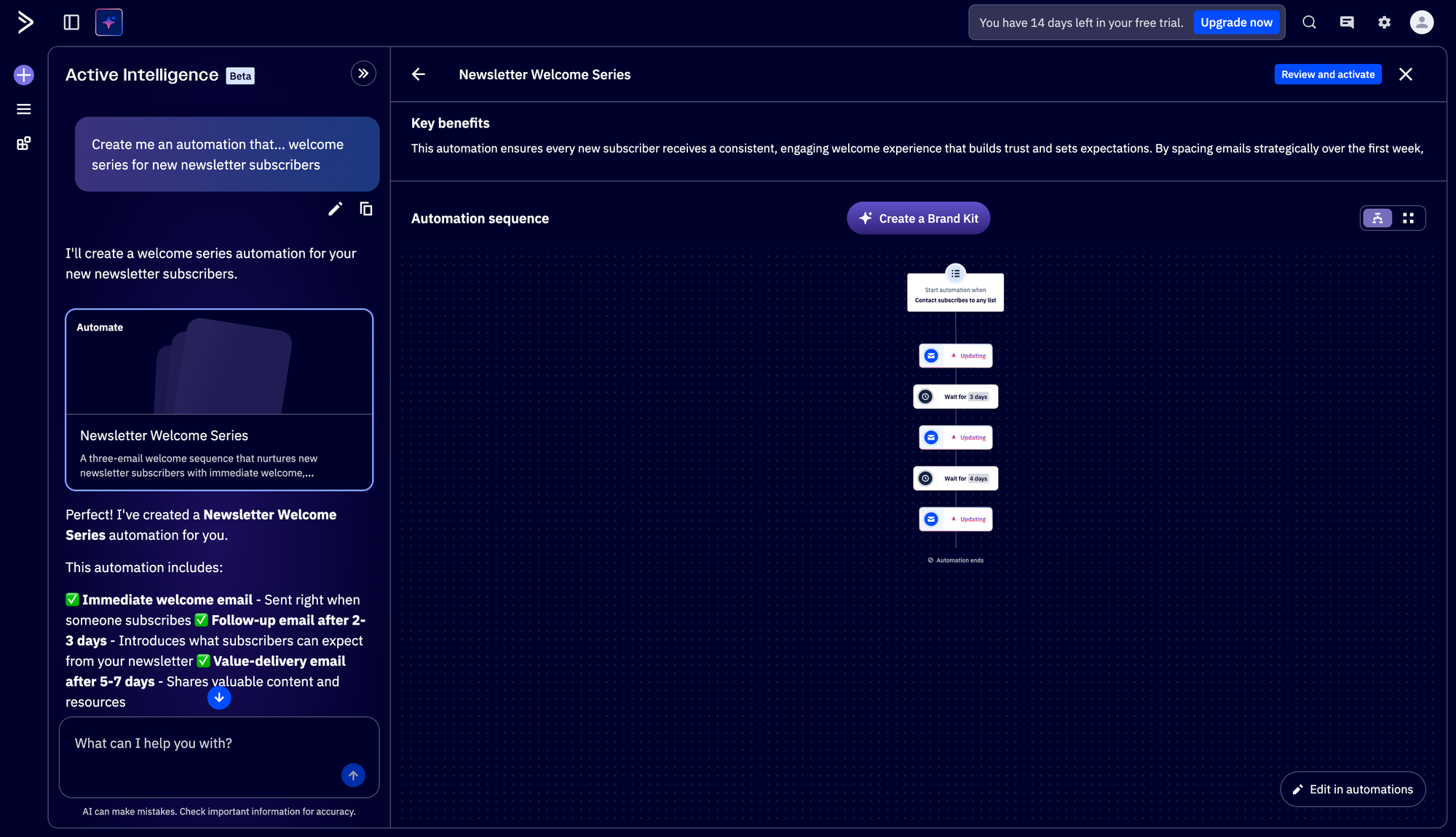
Instead of navigating the complex automation builder, dragging logic boxes, and agonizing over subject lines, I simply opened the Active Intelligence sidebar. I didn’t type a basic command like, “Help me write an email.” Instead, I issued a strategic directive:
“Build a 7-day nurture sequence for new subscribers who downloaded the Q3 marketing report. Highlight the ease of implementing our setup, include a quick-start guide on day two, and keep the tone highly helpful but authoritative. Ensure the ultimate goal is driving a booked discovery call.”
The difference here is profound. The AI agents didn’t just spit out a block of text for me to copy and paste. They actually conceptualized and created the sequence, suggested the optimal timing delays between messages, and set the dynamic personalization rules based on the historical data already sitting in my account.
Deep Dive: Reimagining the Classic Welcome Series
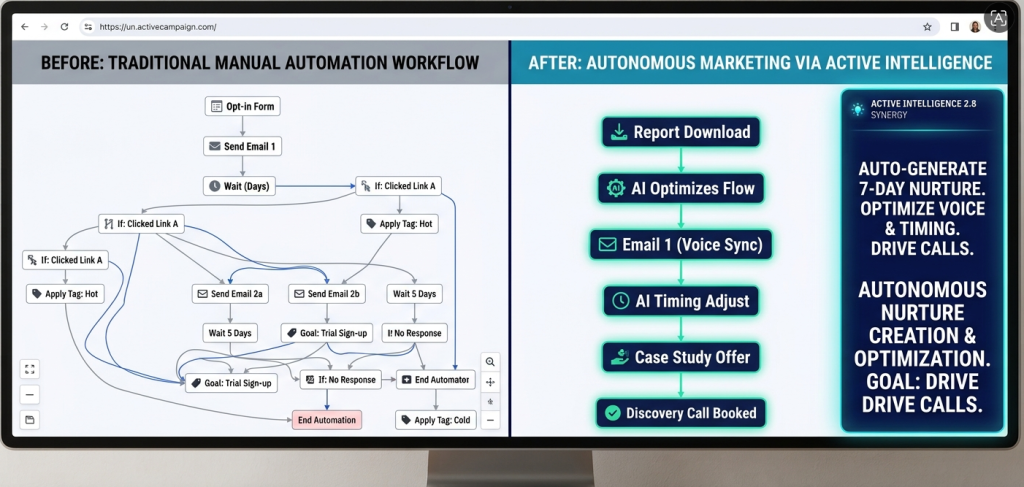
To truly understand the power of Active Intelligence, let’s get hyper-specific and look at the classic “Welcome Series.” In the old days, you would map out five static emails. You would blindly guess the best wait times (Should I wait two days? Three days?). You would write generic content, hoping it vaguely appeals to everyone who happens to join your list.
With AI Agents, the welcome series becomes a living, breathing entity. When I deployed my prompt, ActiveCampaign’s Active Intelligence didn’t just build a linear path. It built a responsive ecosystem. The AI Agent recognized that subscribers who clicked a link in email one were highly engaged and automatically suggested shortening the delay for email two. It recognized that mobile readers engaged better with shorter subject lines and adapted the text accordingly.
I was no longer guessing. The AI Agent was making micro-optimizations in real-time that would have taken me weeks of manual A/B testing to discover.
The 30-Day Experiment: Reality vs. The “Old Way”
To prove this wasn’t just a honeymoon phase with a new feature, I meticulously tracked my time for two weeks, comparing a manual campaign launch to an autonomous one.
The “Old Way” (Manual Execution):
- Researching and isolating audience segments: 2.5 hours
- Drafting 5 emails and researching subject lines: 5 hours
- Building the complex workflow, setting triggers, and testing logic: 4.5 hours
- Reviewing performance and manually tweaking the flow post-launch: 3 hours
- Total Time Invested: 15 hours.
The “Active Intelligence” Way:
- Strategizing and prompting the AI Agent: 15 minutes
- Human refinement and editing the generated assets: 45 minutes
- Performance monitoring and approving AI-suggested optimizations via chat: 15 minutes
- Total Time Invested: 1 hour 15 minutes.
Not only did I win back nearly 14 hours of my week, but my open rates climbed by 14% and my click-through rates jumped by 9%. Why? Because Active Intelligence leverages predictive sending. It analyzed billions of data points from my specific account history to understand exactly when my unique audience actually opens their inbox, delivering the message at the precise moment they are ready to read it.
Proof Point: The Active Intelligence 2.8 Advantage
The real game-changer that separates this from generic AI writing tools is the new Active Intelligence 2.8 update. It solves the single biggest frustration marketers have with AI: “It sounds like a robot, not like me.”
Through the Brand Kit and Custom Instructions, I was able to teach the AI my underlying business goals, my core values, and my specific communication style exactly once. Now, the platform remembers that my brand is “friendly but highly professional, leaning heavily on data,” and that my calls-to-action should always be “value-driven and action-first.”
It is no longer a blank template trying to guess my industry. It is a seasoned strategist that knows my history, my voice, and my audience.
Predictive Scoring: The Silent Revenue Generator
Beyond content creation, Active Intelligence completely transforms how we handle leads. Previously, lead scoring was a manual nightmare. You had to assign arbitrary point values: 5 points for an email open, 10 points for a link click. It was highly subjective and rarely accurate.
ActiveCampaign’s AI Agents now handle this autonomously. The system looks at microscopic, invisible behaviors that humans miss—who is opening emails on a mobile device at 6:00 AM, who visited the pricing page twice but bounced, who lingered on a case study video. The AI synthesizes this data and tells me exactly which leads are ready for a sales conversation right now. It turns dark data into immediate, actionable revenue.
The Cost of Inaction
We are standing at a major inflection point. The marketing landscape of 2026 is brutally unforgiving to those who refuse to adapt.
If your competitors are using Active Intelligence to deploy personalized, data-backed, dynamically optimized campaigns in an hour, and you are still spending three weeks mapping out a static workflow on a physical whiteboard, you have already lost the battle. The cost of inaction is not just wasted time; it is lost market share, burning out your team, and delivering a disjointed experience to your customers.
The Rise of the “AI Agency” Model
You might be reading this and wondering: If AI does all the heavy lifting, what is left for me to do? Am I making myself obsolete?
The answer is a resounding no. What we are witnessing is the birth of the “AI Agency”—a solo operator or small team that leverages digital agents to deliver the massive output of a 20-person corporate department. In this new model, you act as the Editor-in-Chief. You do not write the first draft of the content; you curate the overarching strategy.
You use AI Agents for:
- Deep Research: Using the AI to instantly identify high-impact audience segments you never knew existed within your CRM.
- Rapid Creation: Using the Brand Kit to deploy landing pages and emails that are instantly on-brand and beautifully formatted.
- Continuous Validation: Letting the AI continuously monitor sentiment and ROI, flagging only the underperforming campaigns that genuinely need your human intuition to “course correct.”
By shifting to this model, you increase your strategic throughput. You can run five high-level marketing experiments in the time it used to take you to launch just one.
The Power of the “Human-in-the-Loop”
As you embark on your own autonomous journey, it is critical to remember one thing: the most successful marketers prioritize the “Human-in-the-loop” concept.
While the technology is undeniably impressive, it is only as good as the strategic goals you feed into it. The AI functions as a high-performance engine, but you are still the steering wheel. Your ability to provide nuanced context, creatively refine the AI’s output, and infuse your unique business insight is what creates true resonance with your buyers. That deeply “human perspective” is exactly what separates great marketing from noise. It is the proof that you are intentionally directing the machine, rather than just letting it run wild.
How to Start Your Own Autonomous Sprint
If you are still manually setting up every branch, tag, and trigger of your marketing automation, you are playing the game on Hard Mode. Here is how to begin your transition to autonomy today:
- Audit Your Bottlenecks: What is the one recurring task you absolutely dread? (For me, it was granular list segmentation). Isolate that task first.
- Leverage the Agent Library: Instead of opening a blank workflow builder, open the Active Intelligence chat. Ask the Agent to imagine the goal and propose a structure.
- Train Your Brand Kit: Invest 30 minutes upfront uploading your best-performing historical assets, your brand colors, and your style guidelines so the AI implicitly understands your “voice.”
- Validate, Don’t Build: Shift your mindset. Use the AI’s continuous data insights to pivot your strategy rather than spending your time guessing at what might work.
If you are finally ready to permanently eliminate the busy work, reclaim your week, and start acting as the true architect of your brand’s growth, check out ActiveCampaign and start your autonomous journey here.
The era of manual automation is over. Don’t just automate. Evolve.
Leave a Reply